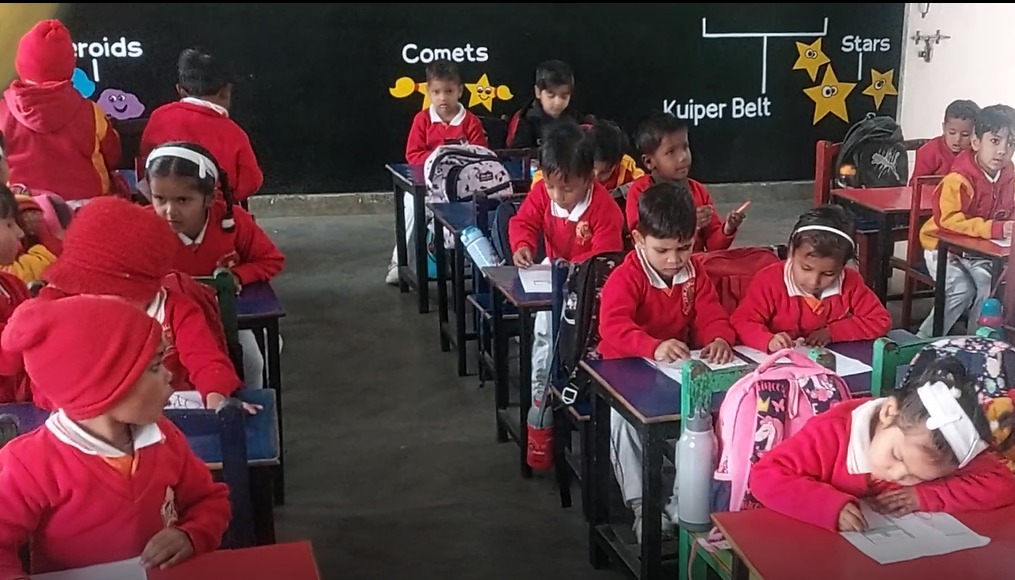
Foundational Stage - (PNC, NC, KG, I and II)
Early Childhood Care and Education in Fledging Stage
Education is a natural process carried out by the child and is not acquired by listening to words but by experiences in the environment.
A child's mind between the time of birth and six years of age is that of an absorbent mind. During this age children have a tremendous ability to learn and assimilate from the world around them. Hence, the
Pre-Primary Department of J.P.M Public School believes in providing our tiny tots, an environment that helps them to explore the world around them by working with concrete material and developing basic cognitive abilities through experiential learning at their own pace. They have the freedom to make creative choices that respond to their evolutionary needs. The activities include sorting, spooning, transferring, folding, pegging and many more.
Students are adequately exposed to good habits of eating nutritious food, health and hygiene, disadvantages of eating junk food, besides other related issues. Teachers are trained to monitor even the minutest issue, for better understanding and awareness among young scholars.
Young learners get hands on experience by performing these activities thereby fostering their growth of independence, concentration and sense of order. It offers opportunities for building confidence and self-esteem, nurturing a happy and motivating environment for their holistic development. It also aids in improving their fine and gross motor skills and paves the way for building stronger foundation.
Every child can learn, just not on the same day, or the same way. As educators, we believe in the process of self- discovery and learning, thereby honing individuality and uniqueness in each child. The focus is laid on creating awareness in students, providing them with experiences that they could apply to real-life situations and make informed choices. The Early Primary Curriculum endorses the focus of National Education Policy (NEP) on foundational literacy of formative years and aims at enriching a joyous vibrant space for our children to enquire, explore and discover their surroundings through various experiential play-way activities. Our team of dynamic and highly committed teachers strives to foster innate curiosity in children through concrete hands-on experiences which occur in contexts that take the shape of 'Themes'.
Learning is enriched with a number of activities such as drama, storytelling, poetry, dance, music, IT modules, discussions and a wide range of creative hands-on activities.
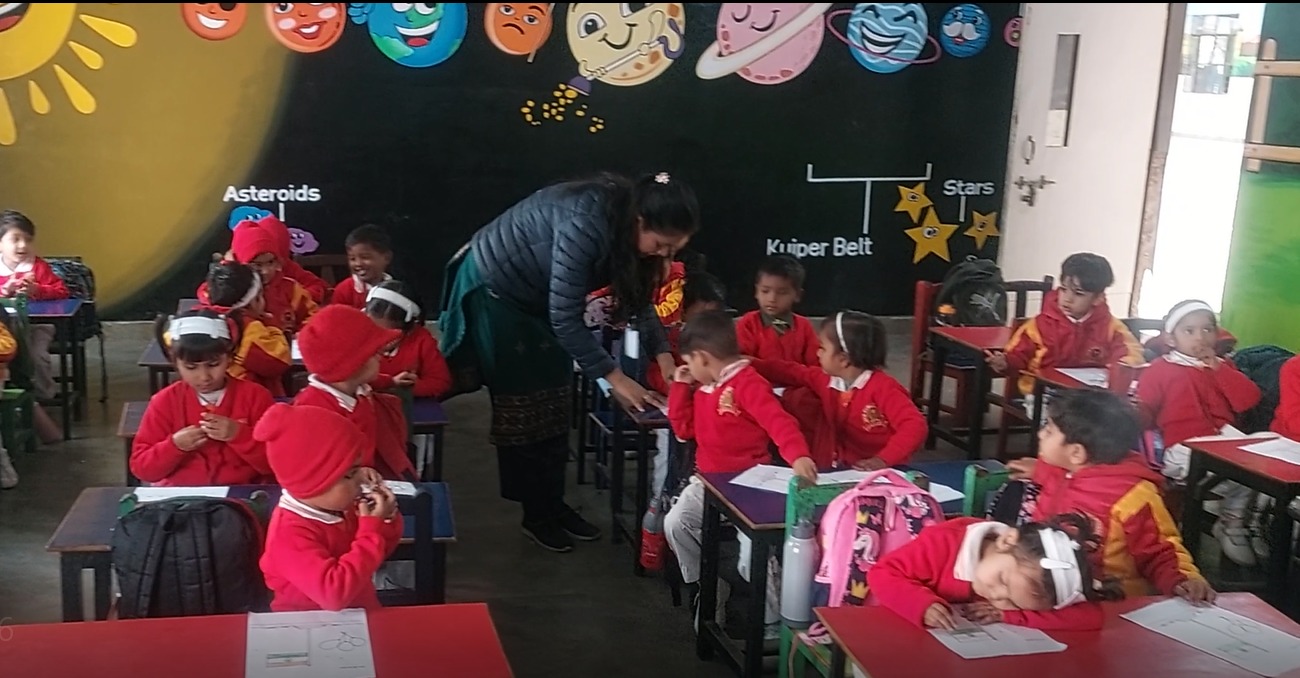
Preparatory Stage - (III, IV & V)
Laying the Foundation for Excellence in Watering Stage
We acknowledge constructive learning that harmonises progressive and traditional methods of teaching-learning. The learners assemble their own learning blocks in an engaging tone.
In the academic year 2024-25, we look forward to your support in our endeavour to bring out the best in our children and to give them a sound moral education while devoting special attention to their spiritual, intellectual, social and physical development.
We are using technology - supported classrooms with the Hybrid Learning Model. Art integrated education is embedded in classroom transactions not only for creating joyful learning but also for imbibing the Indian ethos through integration for Indian art and culture in the teaching and learning process at every level.
We have consciously and invariably endeavoured to evolve a strategy which instils sensitive and ethical sensibility among our learners. Hence every morning we begin our day with Prayer, Mediation and Brain Gym. It further results in better concentration and focused learning.

Middle Stage - (VI, VII & VIII)
Maintaining Excellence throughout the Blossoming Stage The academic ethos of the middle school focuses on nurturing creativity, cultivating confidence, and encouraging compassion.
Our Middle School empowers students to transition from childhood to maturity intellectually and emotionally. It offers a safe, inclusive, and nurturing environment in which students can thrive on change, prepare for high school, and establish good habits for life-long learning.
Unleashing the educational horizons for our young learners, we have created a comprehensive curriculum of excellence that accommodates the diverse cognitive and affective needs of students, and transforms teaching-learning into an exuberant, interactive experience for learners and academicians, as envisioned in NEP 2020. Age-appropriate learning opportunities coupled with co-curricular activities, competent and caring faculty, and state-of-the-art infrastructure as well as active parent involvement to fortify the transactional learning process.
The Middle Wing equips young achievers with the skills and confidence they need to embrace the world beyond school. We utilize experiential learning activities such as story telling, debate, extempore, flip teaching, hands-on experiments and role plays to help students to construct knowledge through their own actions.
Integrated learning activities including inter-disciplinary, multi-disciplinary, and trans-disciplinary projects and events like Save Soil, Millets Project, STEM Fest, Language Fest, Maths Fest, and Heritage Week, facilitate connections between academic subjects and real life experiences. The school also emphasizes the use of digital tools and technology, enabling students to become creators and use technology for societal advancement.

Secondary Stage - (IX, X, XI & XII)
Quality Education through Perseverance in Basking Stage
The Secondary Stage comprises four years of multidisciplinary study, building on the subject oriented pedagogical and curricular style of the Middle Stage but with greater depth, greater critical thinking, greater attention to life aspirations and students choice of subjects.
Our curriculum is equipped with a unique integration of traditional educational theory and practice from India and abroad. We instill a firm traditional and cultural base in our curriculum to ensure a sense of identity, spiritualism and ethics in the students.
JPM Public School, Bareilly seeks to Implement a learning model, using teaching systems and methods that initiate learning activities, encourage the students to focus on the thought and feelings that are being experienced, to derive new learning from the activity and in the process, become more knowledgeable, more confident and a committed individual capable of making informed choices
In line with our Core Philosophy, the teaching and learning model designed by JPM Public School, Bareilly ,thus aims to:
- Emphasize a structured learning process, where the teacher facilitates, inspires and imparts a strong practical slant to the entire learning experience.
- Utilize many varied and interactive teaching methods, including cutting-edge technology to stimulate different areas of intelligence. Our children not only realize the need to learn, but actively want to learn.
- Develop social, behavioral and life-skills in each child so that they become fulfilled and highly productive members of society.
- Make each child responsible for themselves and ready to create a position as a leader in the new economic and social climate.
This is the plus two stage in the (10+2) pattern of education leading to the All India Senior Secondary School Certificate Examination (AISSCE) conducted by the Central Board of Secondary Education (CBSE), Delhi. The school offers two main streams i.e. Science and Commerce . Students have to take five subjects from the available options to qualify for a pass certificate in standard XII.
Science Streams: English, Physics, Chemistry, Biology/Mathematics, Physical Education/Computer Science
Commerce Stream : English, Accountancy, Business Studies, Economics, Mathematics/Physical Education
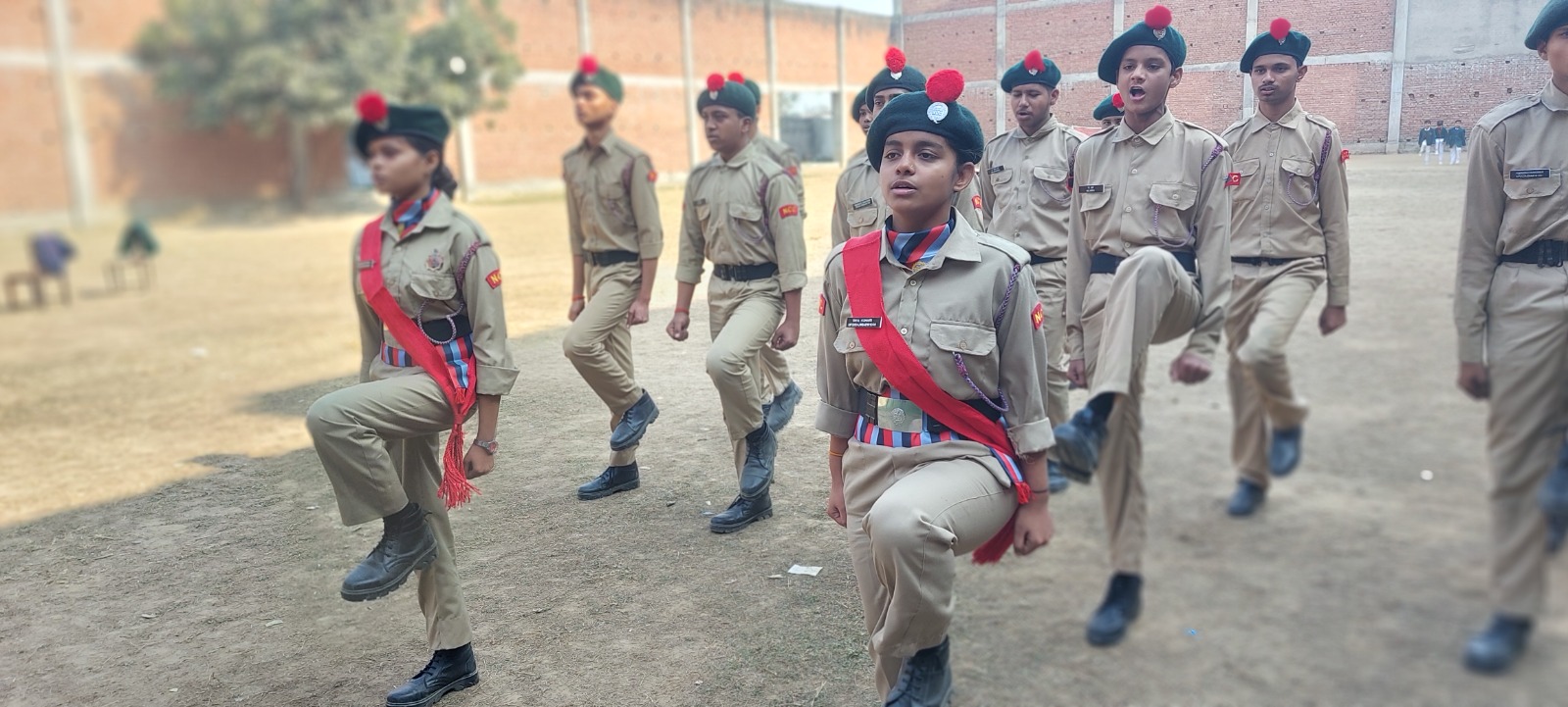
NATIONAL CADET CORPS (NCC)
The training curriculum of the NCC is primarily focused towards character building, inculcating leadership qualities and skill enhancement through structured academic syllabi, practical training and opportunity of exposure/interaction beyond a cadet’s immediate environment and thereby enabling them for a brighter and progressive future.
The Aim of NCC is as listed below:
- (a) To develop character, comradeship, discipline, secular outlook, spirit of adventure and the ideals of selfless service amongst the youth of the country.
- (b) To create a human resource of organized, trained and motivated youth, to provide leadership in all walks of life and always available for the service of the nation.
- (c) To provide a suitable environment to motivate the youth to take up a career in the Armed Forces.
Conduct of Training:
The NCC training curriculum is conducted as under:
- (a) Institutional Training. Conducted in our school by Associate NCC Officers (ANO), Permanent Instructional (PI) staff as part of the school curriculum.
- (b) Annual Training Camps (ATC). To provide practical outdoor training, each NCC cadet attends 10 days camp in the second year of junior and senior division. These camps are conducted by respective NCC units.
- (c) Centrally Organized Camps (COC). These camps are conducted at all India level, as National Integration Camps, attended by cadets from all states.
- (d) Adventure Training. To inculcate a spirit of adventure and team work, NCC cadets undergo various adventure activities such as para jumps, para sailing, trekking, mountaineering and sailing expeditions.
- (e) Attachment Camps. To give the cadets exposure to interact with Regular Army, Navy and Air Force units, attachment camps are conducted, where cadets are attached with these units. To motivate cadets to join the Armed Forces attachment of cadets with Indian Military Academy is also conducted.
- (f) Youth Exchange Programme (YEP). Selected cadets also get an opportunity to visit various foreign countries as part of YEP. In one year approximately 100 cadets visit 10 -11 countries.
- (g) Social Service Activities. The cadets also undertake various social service activities, by conduct of rallies to bring awareness and participate in various relief programmes/activities whenever called for.
Trainers:
To conduct and implement the NCC training curriculum, there are three tiers of trainers.
- (a) First Tier: It comprises of regular defence officers of the rank of Colour equitant rank in Air Force and Navy, Whole Time Lady Officers (WTLO) and Civilian Gliding Instructors (CGI). They are responsible for coordination and supervision of training and conduct of camps.
- (b) Second Tier: Teachers nominated by our school and trained by NCC at its NCC Officers Training Academy and on completion of Pre–Commission Course, commissioned as Associated NCC Officer (ANO) form the most important link between the cadets 436 and NCC. They conduct most of the theory classes of non-specialized subjects. Besides the Pre Commission training they attend refresher courses.
- (c) Third Tier: The Junior Commissioned Officers (JCO) and Non–Commissioned Officers (NCO) from the three services and Girl Cadet Instructors (GCI) and Ship Model Instructors (SMI) conduct the specialized training of the cadets.
Eligibility for Enrolments as Cadet:
- (a) Should be a citizen of India.
- (b) Should be on the roll of our school.
- (c) The cadet should be within the age as mentioned below:-
Junior Division – Not less than 13 years and below 18 years and 6 months.